
Summit County Court Records After Arrest
After a person is arrested in Summit County, the booking event is handled at Summit County Jail. The jail's public list can show current custody, a booking number, a housing or location label, and the time the person was incarcerated. It does not show the filed charge list. Summit County court records after an arrest come from the court side of the process, after the prosecutor decides what to file and the case is entered in Utah's district or justice court system.
The custody record and the court record should not be treated as the same source. The Summit County jail inmate records page is the better route for checking whether a person is housed in the jail. The Summit County jail mugshots page covers booking-photo limits. Court records after a jail arrest are used to track the complaint, information, indictment, hearing dates, warrants, bond orders, charge amendments, dismissals, pleas, verdicts, and final disposition.
Find Summit County Arrest Court Records
The main public case-search path is Utah Courts Xchange, with the search application at Xchange. Utah Courts describes Xchange as a repository for public district court and justice court case information. That matters in Summit County because district court covers felonies and Class A misdemeanors, while justice court covers most Class B and Class C misdemeanors, traffic matters, and infractions.
Use the defendant's legal name first. A Summit County jail booking number follows a jail format, such as a year and sequence number, but the research did not show that it works as a Utah court case number. If the arrest is recent, the court record may lag while the prosecutor reviews the case and court staff enter it. A later search may be needed after first appearance or after formal filing.
| Access route | Best use | Limits |
|---|---|---|
| Xchange | Public district and justice court case search by party or case number. | May require account access, terms, or payment; exact live fields were not exposed in research text. |
| MyCase | Party access for case history, filed papers, payments, and scheduled appearances. | Requires email, case number, and government-issued ID. |
| Justice Court calendar | Checking Summit County Justice Court hearing settings. | A calendar is not a full case file or disposition record. |
| Court clerk channels | Copies, older records, or documents not available online. | Sealed, expunged, juvenile, protected, or restricted records may not be released. |
The Xchange public case-search interface is the source shown in the project image manifest for Utah court case access.
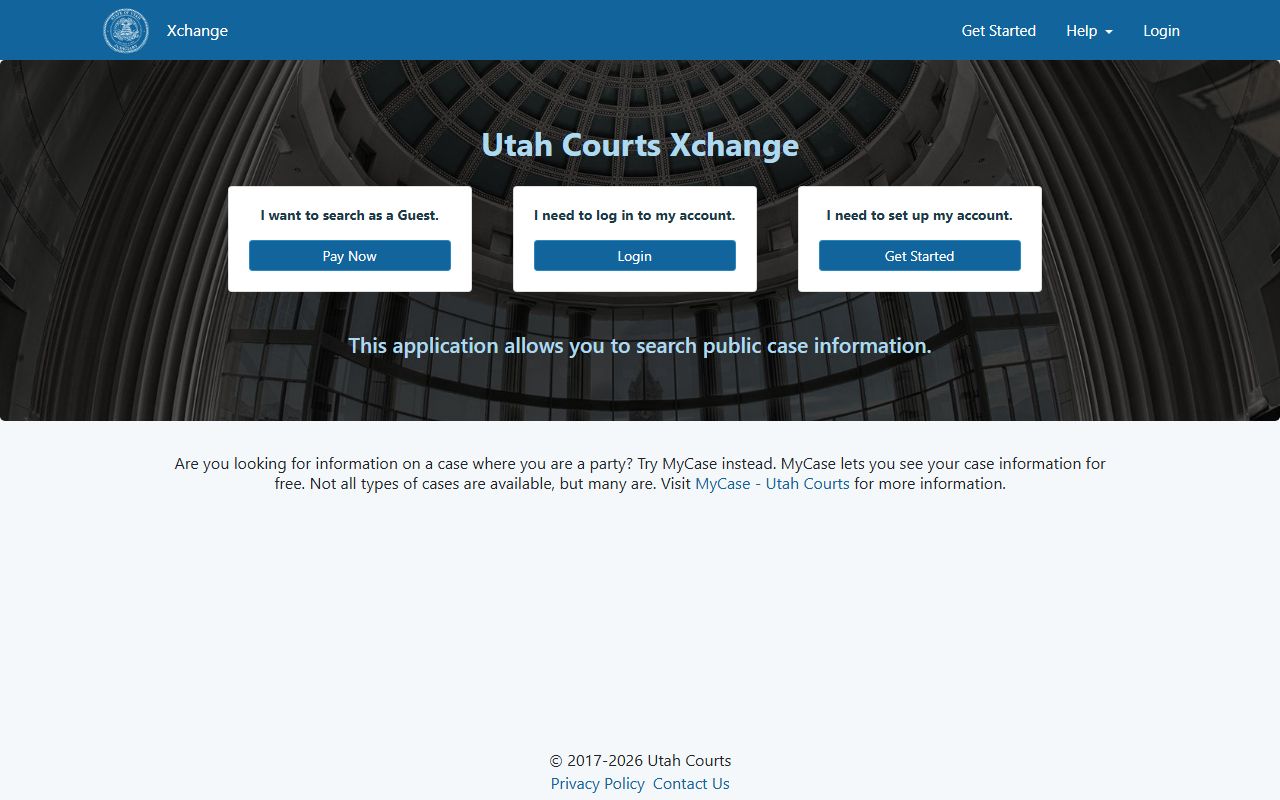
Xchange is the statewide case-search doorway, so it should be used for the court record rather than the Summit County jail PDF when the question is filed charges or case status.
Summit County Court Jurisdiction
Summit County Justice Court handles Class B and Class C misdemeanors, small claims, and related local matters. The Justice Court page also points parties to MyCase for payments, next scheduled appearances, case history, and public filed documents. The page says hearings are virtual through WebEx unless a person is told otherwise, and it tells users without email access to contact the court at (435) 615-3802 for a direct hearing link.
Felony cases and Class A misdemeanors are not handled the same way. Under the Utah Courts Xchange description, district courts are the general jurisdiction courts and include felony and Class A misdemeanor criminal cases. That split is why a Summit County arrest can require both a local justice-court check and a broader Utah district-court Xchange search, depending on the charge level filed by the prosecutor.
The Summit County Justice Court page documents the local misdemeanor court and its virtual-hearing instructions.
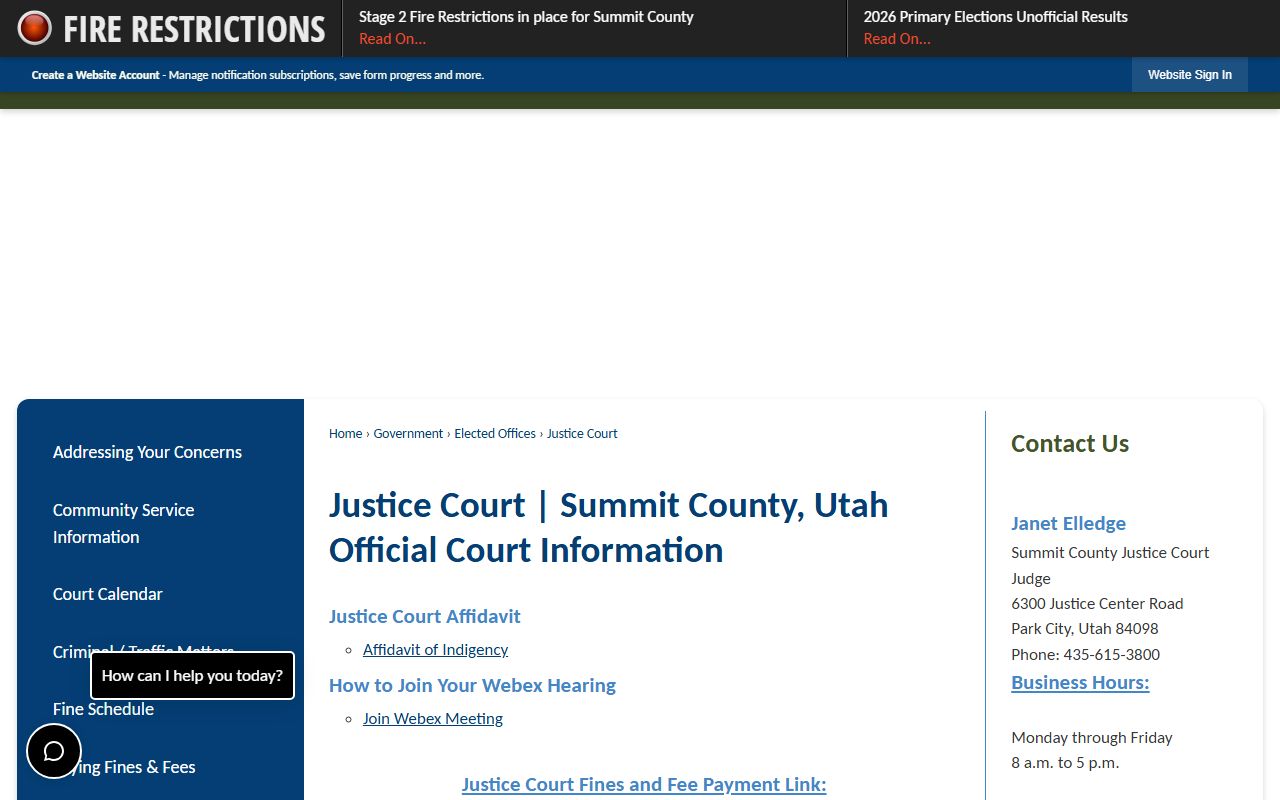
That local court page is useful for hearing access, but Xchange and MyCase remain the main routes for criminal case records and filed documents.
Summit County Attorney Charges
The Summit County Attorney's Office is the charging office for county criminal matters. The Utah Prosecution Council lists Margaret Olson as Summit County Attorney at 6300 Justice Center Road in Park City, with office phone (435) 615-3828. The county attorney's official page separately routes non-State v. Richins office matters to (435) 336-3206, while media inquiries for that named case have separate routing. For ordinary arrest-to-court questions, the key point is not media routing. It is that filed charges come from the prosecutor, not from the jail PDF.
A prosecutor may file a charge that differs from the arrest allegation, decline a charge, amend a charge, reduce a charge, or move to dismiss a count. That is the core difference between a jail arrest and the court records after the arrest. A current inmate list can confirm custody at a point in time, but it cannot prove the final charging decision or outcome.
Summit County Charging Documents
Once an arrest moves to court, the first filed document controls how the accusation is stated in the court record. Utah criminal cases may begin with different charging documents. For Summit County readers, the practical issue is to read the court filing, not just the booking event, because the filed document is where charge names, counts, levels, and case numbers are tracked.
| Document | What it does | Local use note |
|---|---|---|
| Complaint | Starts or supports a criminal case, often near arrest or first appearance. | Common in ordinary criminal filings and early proceedings. |
| Information | Formal prosecutor-filed charge document. | Used in many felony and misdemeanor prosecutions. |
| Indictment | Grand-jury charging document. | Less common for routine county criminal matters. |
Summit County Charge Status
Charge status terms show where each count stands in the court record. They should not be read as proof of guilt unless the case reached a conviction. A pending charge is still unresolved. An amended or reduced charge means the court record changed after filing. A dismissed count is not a conviction on that count. A disposition is the final outcome recorded for the charge or case.
| Status | Plain meaning | Why it matters after arrest |
|---|---|---|
| Pending | The charge is active and not resolved. | The arrest has become a live court case or count. |
| Amended | Charge wording, degree, or count changed. | The filed case no longer matches the earliest accusation exactly. |
| Reduced | The charge was lowered to a lesser offense. | The final charge level may be lower than the initial filing. |
| Dismissed | The charge ended without conviction on that count. | The arrest may still have existed, but the count did not become a conviction. |
| Conviction | Formal guilty plea, verdict, or adjudication. | This is different from arrest, booking, or a pending charge. |
| Disposition | The final recorded outcome. | Use this field to understand how the case ended. |
Warrants and Bond After Arrest
Summit County's bail page says the jail accepts cash, credit cards, and cashier's checks for new bondable charges. For warrant cases, cash bail or a bail bond company may be accepted according to the warrant directives. A warrant directive may also require cash only. No-bail, Adult Probation and Parole, and judge's holds are different. The sheriff says no payment or surety is accepted for those holds, and release requires a judge's order.
No official Summit County public active-warrant search was located in the research. Court records are the best public route for bench-warrant clues because bench warrants usually come from a case. A person arrested on a warrant may appear on the jail list while housed, but the PDF does not show the warrant detail. For urgent custody or release questions, call Summit County Jail at (435) 615-3723 and then check Xchange or the issuing court.
| Situation | Summit County release treatment |
|---|---|
| New bondable charge | Cash, credit card, or cashier's check may be accepted. |
| Surety-eligible warrant | Bail bond company may be allowed if the directive permits it. |
| Cash-only warrant | Cash is required when the warrant directive says so. |
| No-bail or AP&P hold | No payment or surety accepted; judge's order or holding authority controls release. |
Note: Bond terms can change through a court order, so verify the current order before sending money or traveling to the jail.
Charges Versus Convictions
A Summit County arrest, a filed charge, and a conviction are three different points in the criminal process. An arrest means law enforcement took the person into custody. A charge means the prosecutor or court record states an accusation. A conviction means the case ended with a guilty plea, verdict, or other formal adjudication that counts as a conviction. Public court records may show all three kinds of facts, but they do not mean the same thing.
| Record fact | What it proves | What it does not prove |
|---|---|---|
| Arrest | A custody event occurred. | It does not prove the charge was filed or sustained. |
| Charge | A count was filed or pending in court. | It does not prove guilt. |
| Conviction | The charge ended in a formal conviction. | It does not describe every dismissed or amended count by itself. |
Sealed and Expunged Records
Utah's public-records framework is the Government Records Access and Management Act, or GRAMA. GRAMA creates access rights for public records, but it also recognizes private, controlled, protected, restricted, juvenile, sealed, expunged, medical, and safety-related records. A Summit County arrest may have a public court record while the case is active, yet later access can narrow if a court seals or expunges eligible records.
| Access category | General effect | Search result impact |
|---|---|---|
| Sealed | Public access is blocked or limited by court order. | Xchange or clerk access may omit or restrict the case. |
| Expunged | Eligible records are treated as legally cleared from ordinary public access. | Public searches may not show the arrest or case. |
| Protected or restricted | GRAMA or court rules limit release due to privacy, safety, age, or investigation status. | Records may be redacted or withheld. |
BCI and GRAMA Records
Utah Bureau of Criminal Identification has a separate own criminal-history request channel. BCI's own-record page says an in-person request costs $20 and requires valid government photo ID. Utah Driving Privilege Cards are not accepted as valid ID for that purpose. BCI is not a substitute for Xchange when the need is a specific Summit County filing, docket entry, or hearing, but it is the statewide own-record route for a person seeking their own Utah criminal-history record.
For jail records that are not online, Summit County uses public-records channels such as the NextRequest GRAMA portal and the Sheriff's Administrative Division. Use that path for historical booking records, reports, or records the jail PDF omits. The jail PDF itself does not show charges, bond, mugshots, DOB, demographics, arresting agency, warrant number, or court date.
Important: Do not use casual court or jail searches for FCRA-covered screening such as employment, credit, insurance, or tenant decisions.